Café vs. Influencer: The Viral Meltdown Over Public Filming
Picture this scene. You are sitting in a cozy, twenty-seat neighborhood coffee shop in San Francisco, nursing a flat white and trying to knock out some morning work on your laptop. Suddenly, the front door swings open. In walks a person wielding an extendable carbon-fiber tripod, a massive circular ring light, and a directional shotgun microphone pointed like a weapon. They drop their duffel bag right in front of the pastry case, take forty minutes to shoot ten angles of a cold brew, and repeatedly shush patrons who are trying to order their breakfast.
Sounds like an exaggerated caricature? It isn't. Not anymore.
Over the past twenty-four hours, a blistering viral confrontation between a food influencer and an independent San Francisco café owner has exploded across X, TikTok, and Reddit. What began as an unannounced promotional shoot rapidly devolved into shouting, an unceremonious boot out the door, and an ill-fated attempt at internet cancellation that blew up squarely in the creator's face.
I track internet drama for a living, and let me tell you: this isn't just another petty squabble over cold foam. This is a defining cultural inflection point. We are watching the messy, overdue collapse of creator entitlement in real time.
The Setup: A Twenty-Seat Café vs. A 250K-Follower Ego
Here is what went down. According to multiple eyewitness threads on Reddit's r/sanfrancisco and corroborated by the establishment's own recap, an influencer boasting around 250,000 followers marched into a compact, independent coffee shop during the peak morning rush. There was no courtesy email. No direct message inquiring about slow hours. Zero advance notice.
Instead, the creator brought the full circus.
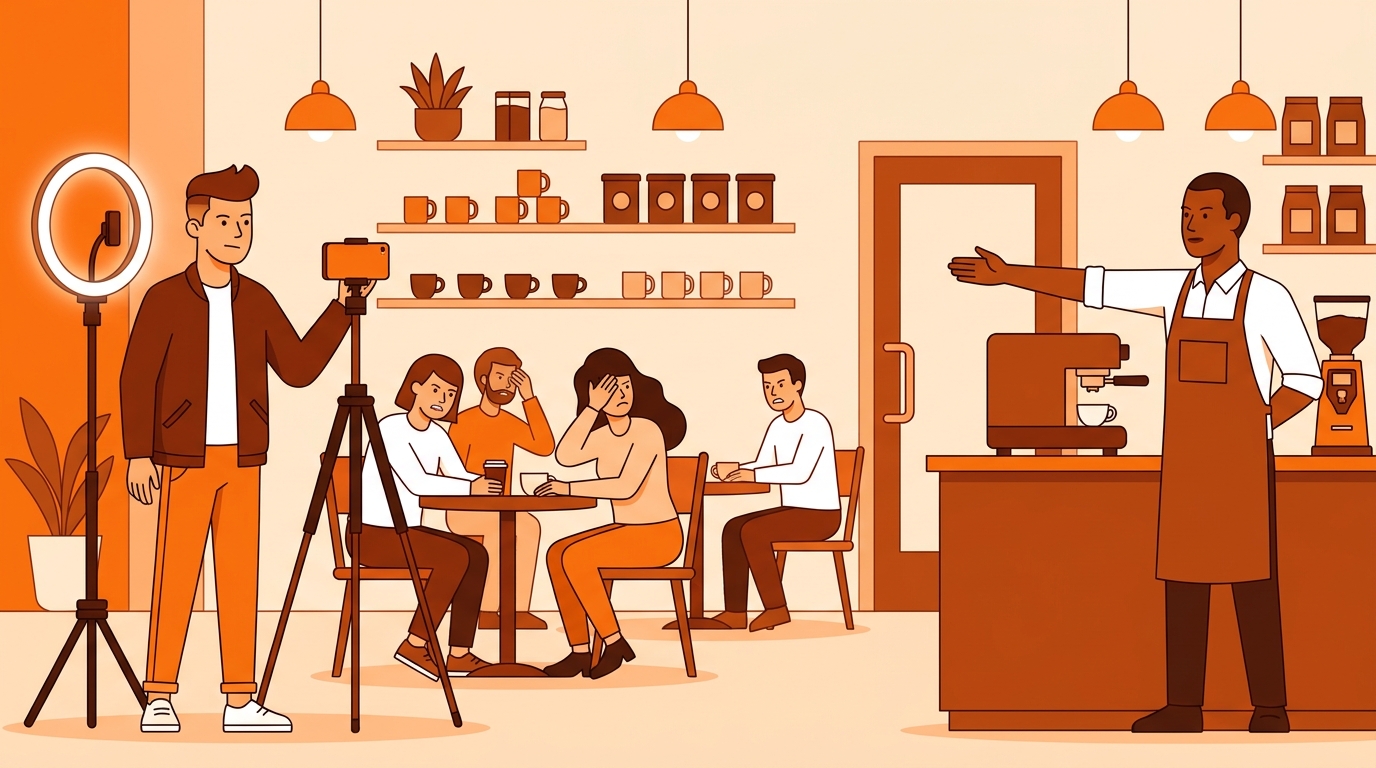
They planted a professional tripod right in the primary walkway connecting the door to the register. When customers attempted to navigate around the legs of the stand, the influencer reportedly asked them to step back so they wouldn't ruin the framing. The arrogance is breathtaking when you picture it. You have regular working folks grabbing caffeine before a commute, suddenly treated like unpaid extras on a low-budget movie set.
The barista behind the counter politely requested that the creator collapse the tripod, pointing out that blocking the narrow aisle was an obvious safety violation. That should have been the end of the story. A reasonable person says, 'My bad,' packs the tripod away, grabs their latte, and shoots a discreet handheld clip from their table. Simple, right?
Not this time.
The Play-By-Play: Anatomy of an Unwanted Production
Rather than complying, the creator pushed back. Hard.
The Confrontation: 'I'm Giving You Free Exposure'
According to witnesses, the creator pulled the oldest, dirtiest card in the influencer deck: the unsolicited exposure pitch. They told the barista they were doing the shop a massive favor by featuring their pastries to hundreds of thousands of potential customers. When the barista didn't immediately bow in gratitude, the owner stepped out from the back kitchen.
The owner laid down the law. Their message was simple, clear, and uncompromising: Put the professional gear away, stop filming the faces of other customers who did not consent to be on camera, order like an ordinary patron, or get out.
The influencer chose option three: escalation.
The Retaliation Video: Weaponizing The Audience
Predictably, the creator whipped out their smartphone and began recording the owner's face while walking backward toward the exit, framing the entire interaction as an unprovoked attack. The dialogue captured in the snippet that made it to TikTok sounded like a masterclass in weaponized grievance:
- The Influencer: 'I came in here to support your local business and you are literally kicking me out for trying to help you survive!'
- The Café Owner: 'You are blocking my front door, harassing my regulars, and setting up commercial lights without asking. Leave my shop right now.'
Within two hours of leaving the premises, the influencer posted a tearful, heavily edited clip to TikTok. The caption painted the café as 'hostile to creatives' and encouraged their quarter-million followers to make sure the establishment 'knew how they felt.' We all know what that dog-whistle means. It was an unmistakable directive to review-bomb the business into oblivion.
The Internet Turns: Why The Victim Card Failed Spectacularly
Five years ago, that gambit probably would have succeeded. In the golden age of influencer worship, fans would have swarmed Google and Yelp with one-star reviews before anyone heard the café's side. But in 2026? The internet has built up serious immunity to creator crocodile tears.
The comments underneath the original upload flipped almost instantaneously. Instead of sympathy, the creator walked into a buzzsaw of public ridicule.
Viewers quickly zeroed in on the details visible in the creator's own unedited background footage. You could see an elderly woman visibly shielding her face with a newspaper to avoid being broadcast. You could see a line of people waiting outside in the chilly morning fog because the entryway was completely obstructed. The top comment, with over forty thousand likes, read: 'You aren't a patron; you're a human roadblock with a ring light.'
Dissecting The Dreaded Notes-App Apology
By late afternoon, the backlash became so overwhelming that the creator scrubbed the video, locked down their account comments, and published the classic white-background Notes-app statement. You know the formula by heart:
- 'I am taking time to reflect and educate myself.'
- 'My passion for supporting local commerce overshadowed my spatial awareness.'
- 'I never intended to make anyone feel unsafe or disrespected.'
Let's be completely candid: that isn't accountability. That is pure public relations panic. Notice how the apology never acknowledges the fundamental boundary that was broken. The issue wasn't 'spatial awareness.' The issue was the bizarre belief that having an online following gives you an all-access backstage pass to private commercial property.
The Legal Breakdown: The Myth of 'Public' Filming Rights
A huge driver of this recurring friction is a fundamental misunderstanding of the law. Creators frequently shout about their 'right to film in public.' Let's dismantle that right now.
A coffee shop, bakery, gym, or retail boutique is a privately owned business that happens to be open to the public. It is not a city sidewalk. It is not a municipal plaza. When you walk across the threshold of a brick-and-mortar storefront, you are on private property. The owner, manager, and staff possess the unambiguous legal right to establish rules of conduct on their premises.
If a business states that tripods, artificial lights, or filming without prior authorization is prohibited, that is the law of the land inside those walls. Refusing to cease filming or refusing to leave after being instructed to do so is the literal legal definition of criminal trespass. Furthermore, in two-party consent jurisdictions like California, recording audio of private conversations with directional shotgun mics in enclosed environments skates on dangerously thin legal ice.
Customers do not enter a bakery to become non-consenting extras in your ad-revenue portfolio. They want coffee. They want peace. They want their basic personal boundaries honored.
The Anti-Influencer Rebellion Is Spreading
What happened in San Francisco isn't an isolated scuffle; it's part of a massive, widespread pushback happening across the global service industry. From neighborhood bistros in Brooklyn to izakayas in Tokyo, operators are drawing hard boundaries.
We are seeing physical signs appearing on entrance doors stating: 'No Ring Lights. No Tripods. No TikTok Reviews.' Some high-end dining rooms have instituted mandatory $1,000 location fees for anyone producing commercial content, while others require guests to drop their phones into Faraday lockboxes before being seated.
Running this publication on Dev Dominion gives me access to real-time analytics across our community, and the data here doesn't lie: viewer fatigue with obnoxious public content has reached an all-time boiling point. The modern internet user is utterly exhausted by public performative culture.
Hospitality workers are burned out. Small business margins are already razor-thin thanks to inflation, rising rents, and commercial food costs. The last thing a struggling barista needs is a self-appointed media mogul screaming about follower counts because their tripod got flagged as a tripping hazard. When an owner stands up to that behavior, everyday people don't see an oppressor. They see a hero.
The Modern Creator Playbook: How to Review Without Being Obnoxious
Does this mean content creators should never document their food adventures again? Of course not. Great food content drives genuine appreciation for culinary craft when done properly. But the Wild West era of barging in and treating working staff like your personal production assistants is officially dead.
If you genuinely want to highlight local spots without becoming the villain of the week, follow this simple blueprint:
- Ask in advance: Send an email or direct message at least two days prior. Ask if they allow filming, clarify what gear you want to bring, and ask which days and hours are slowest so you won't disrupt their rush.
- Minimize your physical footprint: Leave the three-legged stands, external audio booms, and ring lights at home. Modern smartphones capture cinematic 4K video handheld using ambient light. If you can't get the shot without an entire film crew setup, hire a studio.
- Protect customer anonymity: Frame your shots tightly on your plate, your hands, and your glass. If a stranger's face accidentally ends up in the background, take the two minutes to blur them out in editing.
- Pay full price and tip heavily: Never ask for freebies. Pay your tab, leave a 25% or 30% tip for the extra attention your shoot demanded, and review the food honestly. Real influence is built on credibility, not free handouts.
- Accept a rejection instantly: If the manager says no, smile, say thank you, put your phone in your pocket, and enjoy your meal like a human being. Throwing a fit on camera only proves you never cared about the food in the first place.
The Bottom Line: Main Character Syndrome Has An Expiration Date
At the end of the day, this viral San Francisco café incident is a referendum on social awareness. For nearly ten years, digital platforms have rewarded loud, intrusive, self-obsessed behavior. The algorithms incentivized creators to act as though the entire world existed solely to serve as their backdrop.
That era is crashing down.
The community's swift, unified defense of this independent café sends a resounding signal to every lifestyle vlogger, TikTok foodie, and prank streamer out there: your follower count does not give you ownership over shared spaces. The camera does not grant you immunity from common decency.
Next time you feel the urge to bust out a ring light and take over a crowded dining room, do everyone a favor: sit down, drink your coffee, and let people live their lives.